
If you’re thinking about giving your existing kitchen a new lease of life, one of the first decisions you may come across is whether to have your kitchen cabinets hand painted or spray painted.
Both methods can produce attractive results when carried out correctly, but they are very different approaches. And when you’re having your kitchen painted in your own home, there are some important practical considerations to think about.
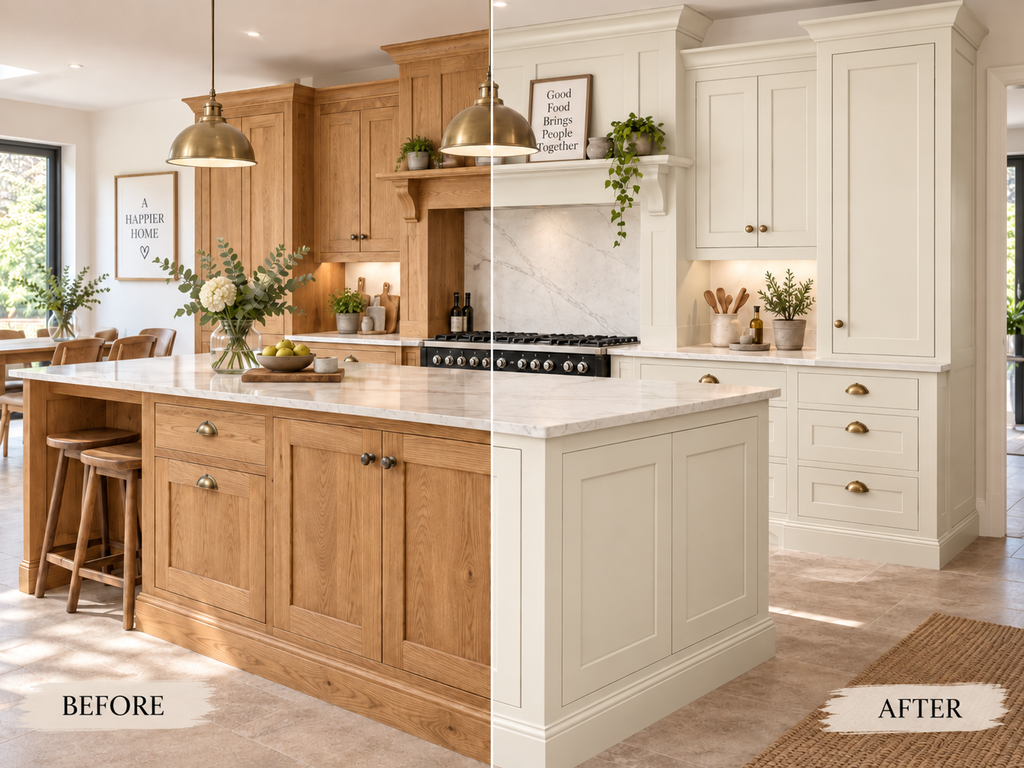
Which Is Best for Your Home?
As a specialist in hand painted kitchens in Nottingham, I’ve spent more than 40 years working with paint, finishes and different surfaces in hundreds of homes throughout the East Midlands and across the UK. Over that time, I’ve learned that achieving a beautiful kitchen isn’t simply about applying paint. It’s about the preparation, the products, the application and, perhaps most importantly, understanding the surface you’re working with.
Whats the difference in hand painting and spray painting kitchens?
Spray painting involves applying the paint using specialist spray equipment. Kitchen doors are often removed and sprayed either in a workshop or, in some cases, on site within the customer’s home. Either way, the carcass frames, end panels remain in-situ and will require finishing in whichever process you decide to go for.
Hand painting is a much more traditional process. The paint is carefully applied by brush, and sometimes a combination of brush and roller, depending on the particular surface and finish required.
When done properly, both methods can produce a high-quality finish.
However, hand painting has some particular advantages when an existing kitchen is being renovated in the home.
The benefits of hand painting your kitchen cabinets
One of the biggest advantages of hand painting an existing kitchen is that I dont have to mask off every area thats not going to be painted. Most of the homes I work in, the customer will still require the kitchen to be operational. Of course they keep out of the way during working hours but when I’ve left for home on an evening, they will want to make a family meal or use other appliances. Some people do not want to empty every single cupboard or have access restricted due to heavy masking up if spraying is involved.
1. Your kitchen can remain operational
Doors and drawers will still be removed where appropriate and taken off site to be prepared and painted, while the fixed cabinetry can be carefully prepared and painted in position. Your kitchen will not be out of bounds whilst being hand painted.
This can make the process much less disruptive.
For many homeowners, particularly those with a well-made traditional or bespoke kitchen, keeping the existing kitchen intact is important.
Why replace a perfectly good kitchen simply because the colour or finish no longer suits your home?
A professional kitchen repaint can transform the appearance while retaining the cabinetry, layout and character that you already have.
2. A more traditional, hand-crafted finish
There is something special about a kitchen that has been carefully painted by hand.
A hand-painted finish can retain a subtle sense of craftsmanship that is particularly suited to traditional, painted and bespoke kitchens.
I believe the skill is in knowing how much paint to apply, how to work it, how to follow the shape and detail of a door, and how to achieve a consistent finish without losing the character of the original kitchen.
For me, hand painting isn’t simply putting paint on a door. The preparation and application require patience, experience and attention to detail. Over the years I have sourced, tried, tested and fine tuned, the best tools, brushes and equipment for the job in hand. Together with high quality, durable paint systems.
3. Better suited to detailed and traditional kitchen doors
Many existing kitchens have mouldings, beading, grooves, panels and other architectural details.
These features need to be properly prepared and carefully painted.
With hand painting, I can work into these areas individually and make sure that the paint is applied correctly around the details.
This is particularly useful when working on bespoke and traditionally constructed kitchens, where preserving the character of the cabinetry is part of the appeal. Equally, I can paint 30+ shaker style doors to a beautifully smooth, brush mark free finish.
4. Easier to manage within an occupied home
Most kitchen painting projects take place while the homeowner is still living in the property.
That means the way the work is carried out matters.
Spray painting requires careful control of overspray and airborne paint particles. In a customer’s home, this means extensive masking and protection may be required.
With hand painting, I can work in a much more controlled manner, concentrating on the individual areas being painted.
Of course, the kitchen still needs to be properly protected and prepared, but the process can be much more manageable in a domestic environment.
5. Less extensive masking and containment
Spray application creates an airborne mist of paint. This is one of the major practical considerations when spraying inside someone’s home. Many of the spray painted finishes used today are super fast drying, they contain resins and hardeners to enable the spray finish to be completed within a day.
To spray successfully, surrounding areas need to be thoroughly protected
That can mean masking:
- Worktops and surrounding surfaces
- Walls
- Flooring and furniture
- Electrical Appliances
- Handles and hinges removed (I do this as standard practice, but have seen many that dont).
- Contents of cupbords
- Doorways
- Adjacent rooms
- Ceilings and other nearby surfaces
Even with careful preparation, spray painting inside a home requires very good containment, ventilation and extraction.
Hand painting doesn’t eliminate the need for protection, but there is considerably less risk of airborne overspray travelling beyond the immediate working area. One question I often get asked by potential clients is “Will i still be able to use my kitchen?” the simple answer is Yes!
The potential disadvantages of spray painting in your home
It’s important to say that spray painting isn’t necessarily a bad method.
In a properly equipped workshop, with the right equipment, extraction, preparation and controlled conditions, spraying can produce an excellent finish.
The situation is different when spraying is undertaken inside someone’s home.
Overspray can be a significant concern
Spray equipment turns paint into a fine mist so that it can be evenly deposited onto the surface. Many spray painters will use whats known as HVLP – High Volume Low Pressure spraying equipment. However this does not eliminate overspray or airborne mist particles. Although I will wear appropriate PPE as necassary, I do not need to go about my job, dressed like a Scenes Of Crime Investigator.
That is precisely what makes spraying effective, but it also creates the possibility of overspray settling on surrounding surfaces.

A professional decorator who is spraying in a home therefore needs to spend considerable time creating an effective containment area.
If the preparation and masking aren’t meticulous, paint mist can find its way onto areas where it isn’t wanted.
More disruption than you might expect
Spray painting can sometimes sound like a quick solution.
However, when spraying inside a customer’s home, the preparation can be extensive.
The area has to be protected, equipment needs to be set up, ventilation and extraction needs to be considered and the surrounding environment needs to be controlled.
Once the spraying has finished, everything still needs to be carefully dismantled and cleaned.
For a homeowner, this can mean considerably more disruption than they initially anticipated.
Ventilation and airborne particles
Spraying creates airborne paint particles, which is another reason why suitable extraction, ventilation and appropriate protective equipment are important.
This is particularly relevant in a kitchen, where the working environment is part of an occupied family home.
A hand-painted approach avoids creating the same level of airborne overspray.
The finish isn’t automatically better because it’s sprayed
There’s a common perception that spraying automatically produces a superior finish.
That’s not necessarily the case.
In the unfortunate case that your newly painted kitchen gets damaged, its very difficult to carry out any kind of touch up or repair. The whole area will require a re-spray. Damage to hand painted finishes can be easily rectified.
A beautifully sprayed finish requires excellent preparation, the correct products, suitable equipment, correct application technique and controlled conditions.
If the preparation underneath isn’t right, spraying won’t hide the problem.
In fact, good preparation is arguably more important than whether the final coat is applied by brush or spray.
Preparation is where the real quality begins
Whether a kitchen is being hand painted or sprayed, preparation is absolutely critical.
Kitchen cabinets are exposed to grease, cooking vapours, moisture, fingerprints and years of everyday use.
Before applying any new coating, the existing surfaces need to be thoroughly cleaned and prepared.
Depending on the existing finish and the condition of the cabinetry, this may include cleaning, degreasing, sanding, repairing damaged areas, priming and applying suitable finishing coats.
This is where experience really counts.
After more than four decades as a specialist kitchen painter and surface finisher, I’ve learned that you cannot rush preparation and expect a first-class finish.
Why I choose to hand paint kitchen cabinets
For my kitchen renovation work, I choose hand painting because it allows me to work closely with the existing kitchen and the individual characteristics of each cabinet and door.
Every kitchen is different.
Some have been painted before. Some have natural timber finishes. Others may have years of wear and tear that need addressing before painting can even begin.

I don’t believe in treating every kitchen as though it were identical.
My approach is to assess the existing surfaces, prepare them properly and then build the finish carefully.
The result should look like a kitchen that has been properly renovated, rather than simply having had a coat of paint put over it.
A more sustainable alternative to replacing your kitchen
There is another benefit to repainting an existing kitchen that is often overlooked.
If your kitchen cabinets are structurally sound and you are happy with the layout, you may not need to replace the kitchen at all.
Changing the colour can completely alter the appearance of the room.
Instead of removing perfectly usable cabinetry and sending it to landfill, hand painting allows you to keep what you already have and give it a new lease of life.
A new colour can make a traditional kitchen feel contemporary, brighten a darker room or simply bring an older kitchen back into keeping with the rest of your home.
Hand painted kitchens in Nottingham and the East Midlands
At Russ Pike Interiors, I specialise in hand painting existing kitchens for homeowners who want to transform their kitchen without replacing it.
Based in Nottingham, I work with homeowners across Nottinghamshire and the wider East Midlands.
With more than 40 years of experience as a specialist kitchen painter and surface finisher, I take a traditional, hands-on approach to every kitchen I work on.

For me, it’s about much more than changing the colour.
It’s about careful preparation, quality materials, attention to detail and taking pride in the finished result.
If your existing kitchen is well made but looking tired, dated or simply no longer suits your home, it may not need replacing.
Sometimes, all it needs is a fresh approach — and a skilled hand with a paintbrush.
Thinking about having your kitchen painted?
If you’re considering having your existing kitchen hand painted in Nottingham, West Bridgford, Derby, Leicester, Loughborough, or elsewhere across the East Midlands, please feel free to Get in Touch I will be happy to discuss your project in more detail and provide you with a cost.
I am a proud member of HPKUK – Hand Painted Kitchens UK and the Traditional Painter Network
Your kitchen may have more life left in it than you think. Here is my guide to choosing a Specialist Kitchen Painter in Nottingham