
One of the first questions I’m asked by homeowners considering having their existing kitchen repainted is:
“How much does it cost to have a kitchen hand painted?” Can you get a idea of how much? Yes Get in touch here.
It’s a perfectly reasonable question. If you’re thinking about giving your kitchen a new lease of life, you naturally want to know what sort of investment you’re looking at.
The difficulty is that there isn’t one fixed price for hand painting a kitchen, as there are so many variables.
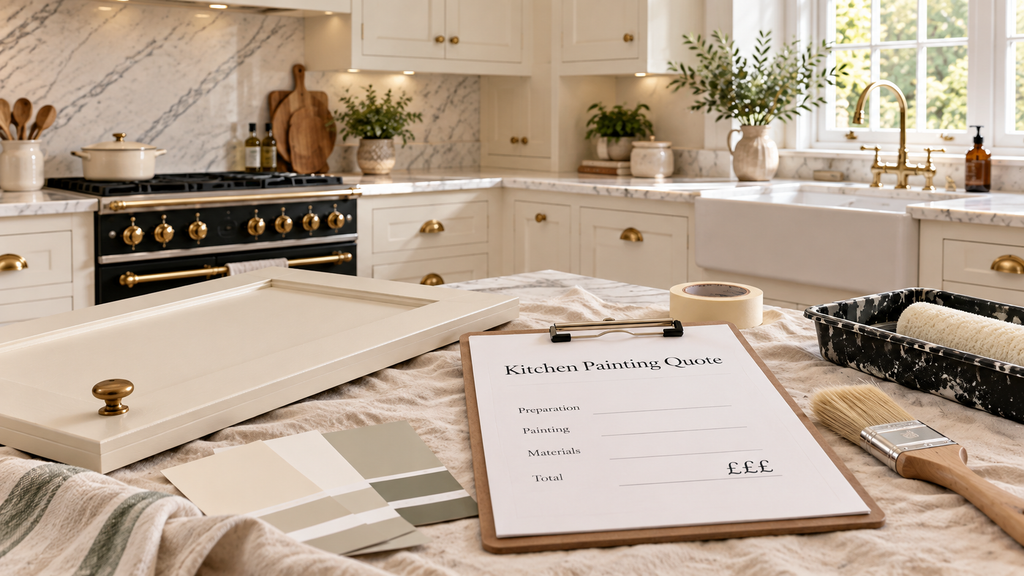
Every kitchen is different, and the cost depends on a number of factors, including the size of the kitchen, the number of doors and drawers, the existing finish, the condition of the cabinetry and the amount of preparation required.
As a specialist in hand painted kitchens in Nottingham and the East Midlands, I believe it’s important that homeowners understand what they’re actually paying for.
Why do kitchen painting prices vary?
A kitchen might have 10 doors and a few drawers, while another could have 30 or 40 doors, deep drawers, end panels, cornices, pilasters and other detailed features.
Two kitchens of a similar size can therefore take very different amounts of time to prepare and paint.
The cost isn’t simply based on the amount of paint used.
A professional kitchen repaint involves preparation, protection, repairs where necessary, priming, painting and finishing. I will often spen the first 2 to 3 days preparing your kitchen and most decent sized kitchens will take between 7 to 10 days to fully complete.
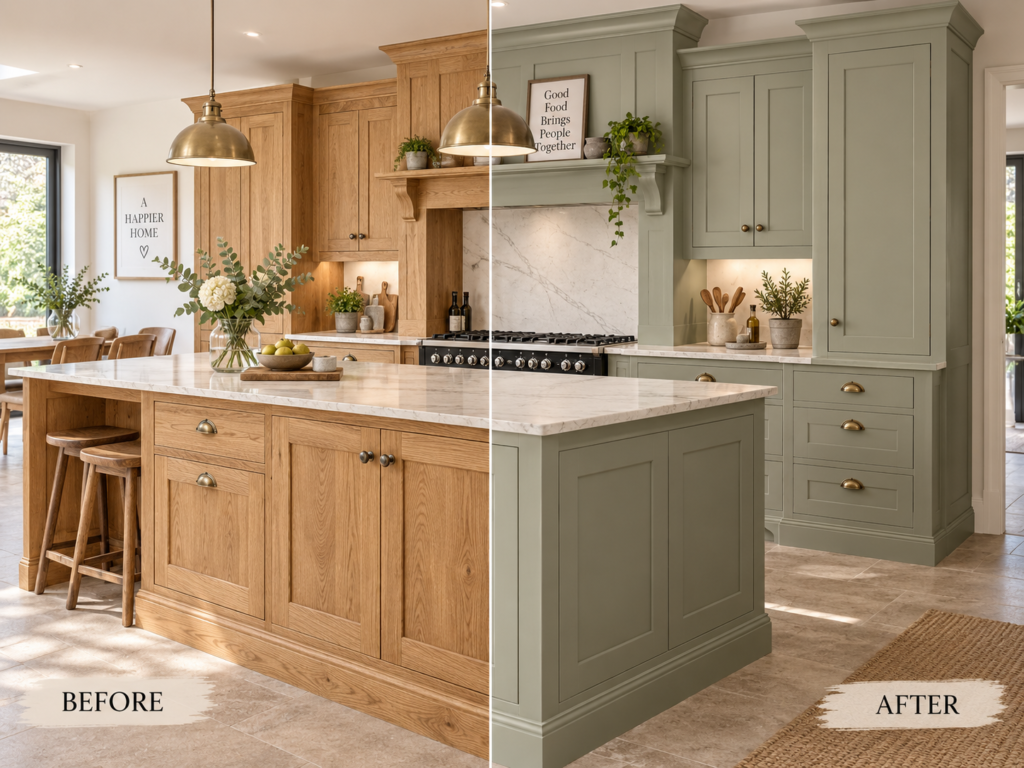
The quality of the final result is heavily influenced by the time spent on those stages. I am meticulous, methodical but work efficently. I have painted hundreds of kitchens and my process has been fined tuned to work effectively.
What is included in the cost of hand painting a kitchen?
When you’re comparing quotes, it’s worth looking beyond the final figure.
Ask what is actually included.
1. Preparation
Preparation is one of the most important parts of the entire process.
Kitchen cabinets are exposed to grease, cooking vapours, moisture, fingerprints and everyday wear.
Before any paint is applied, the surfaces need to be thoroughly cleaned and prepared.
Dust Free Sanding – I have invested in the best quality dust free sanding equipment, read more about it here.

Depending on the existing finish, this can involve:
- Cleaning and degreasing
- Sanding
- Keying the existing surface
- Filling minor imperfections
- Repairing damaged areas
- Priming
- Preparing edges and detailed areas
This preparation takes time, but it is what helps create a durable and professional finish.
2. Protecting your kitchen and home
In most cases (other than a new installation) a kitchen is not an empty room waiting to be painted.
There are worktops, flooring, appliances, sinks, walls and other areas that all need protecting.
Before I begin painting, I take care to protect the surrounding areas so that I can work neatly and safely within your home. Any breakables should be cleared from the area, prior to any work starting.
This preparation and protection is part of the job — and therefore part of the cost.
3. The number of doors and drawers
The number of individual components is a major factor.
A kitchen with 15 doors and 5 drawers is obviously going to require less preparation and painting than one with 30 doors and 12 drawers.
But it’s not just the number of doors.
The style of the doors also makes a difference.
A shaker style door is relatively straightforward, whereas a traditional door with mouldings, beading and recessed panels can require considerably more preparation and careful painting. Oak doors will require a different type of primer than an MDF door. Glazed doors will obviously take longer than a plain door.
The condition of your existing kitchen matters
A kitchen that is already in good condition and has a suitable existing finish may require less preparation than one that has been neglected or poorly painted in the past.
If there are areas of peeling paint, damaged timber, cracks, dents or previous coatings that aren’t adhering properly, these issues need to be dealt with before the new finish can be applied.

Image for illustration purposes only
This is particularly important if the kitchen has previously been painted by someone without the appropriate experience.
Paint can only be as good as the surface underneath it.
Trying to save money by reducing preparation can ultimately prove a false economy.
Does the type of kitchen affect the price?
Yes.
I work on a wide variety of kitchens, including traditional timber kitchens, painted kitchens and bespoke cabinetry.
Some kitchens have intricate mouldings and architectural details that require more time and care.
Others may have large areas of cabinetry, end panels, islands, dressers or fitted furniture that all need to be incorporated into the finished scheme.
This is why I prefer to look at the kitchen before providing a quotation rather than trying to give an arbitrary price based on a photograph or the number of cupboards alone. Photographs are always helpful for an initial guide and I can provide an estimate based on these, providing they show all areas to be painted with close ups of any damaged or particularly worn areas.
What about the cost of paint and materials?
Quality materials are another consideration.
A professional kitchen finish requires suitable primers and topcoats that are designed to cope with the demands of a busy kitchen environment.
The cheapest paint isn’t necessarily the most economical choice.
Using appropriate professional materials, together with correct preparation and application, helps create a finish that is designed to withstand everyday use.
Is hand painting more expensive than spray painting?
Not necessarily — and it’s important to compare like with like.
A spray-painted kitchen can sometimes appear to be the cheaper option, particularly if you’re simply comparing the application of paint.
But the overall cost of a professional kitchen renovation depends on the complete process.

If doors are removed and transported to a spray workshop, there can be additional costs associated with removal, transportation, preparation, spraying, drying, storage and refitting. I will always remove all doors, drawers and kickboards as it makes a much more professional job. I also remove the cabinet hardware including hinges. In most cases the doors and drawers are taken back to my workshop to be prepared and painted.
If spraying is carried out inside your home, extensive masking and containment may also be required to control the overspray.
With hand painting, much of the work can be carried out carefully in situ, which can make the process more straightforward for homeowners. Your kitchen can still be operational during this process.
The important thing isn’t whether a kitchen is painted with a brush or spray gun.
This article might be helpful in making your choice Hand Painted vs Spray Painting a Kitchen
It’s the quality of the preparation, materials, application and workmanship.
Is it cheaper to replace my kitchen?
This is another question I hear regularly.
If your existing kitchen is structurally sound and you are happy with the layout, repainting can be a very effective alternative to a complete replacement.
You may already have good-quality cabinets, solid timber doors and a kitchen that works perfectly for your family.
Replacing everything simply because the colour has become dated can be an expensive undertaking.
Hand painting allows you to keep the kitchen you already have while changing its appearance.
A new colour and often new cabinet hardware can make an enormous difference. Have a look at my guide for Colours for Kitchens and my recommended supplier for Cabinet Hardware at Slingers1858 Ironmongers.
It can make a dark kitchen feel lighter, give a traditional kitchen a more contemporary appearance or simply bring tired cabinetry back to life.
So, how much does a hand painted kitchen actually cost?
There is no single price that applies to every kitchen.
The best way to establish the cost is to assess the kitchen individually.
Factors I would consider include:
The size of the kitchen
How many doors, drawers and other areas require painting?
The style of the doors
Are they flat, moulded, panelled or highly detailed?
The existing finish
What material and coating are currently on the cabinets?
The condition
Does the kitchen require repairs or extensive preparation?
The colour change
Some colour changes may require additional preparation or coats to achieve the desired finish.
The areas being painted
Are you painting just the doors and drawer fronts, or the complete kitchen including fixed cabinetry, panels and other features?
The materials required
Professional primers, topcoats and preparation materials all form part of the project.
New cabinet hardware may also be an option. I do work closely with a highly recommended Ironmongery Supplier, who offer my clients some great discounts when purchased directly.
Why I prefer to quote for each kitchen individually
After more than 40 years working as a specialist kichen painter and surface finisher, I’ve learned that no two kitchens are quite the same.
That’s why I prefer to see the kitchen and understand exactly what is involved before giving a quotation.
It means I can assess the existing finish, look at the condition of the cabinetry and discuss what you’d like to achieve.
Most importantly, it allows me to explain exactly what I recommend and what is included in the price.
There shouldn’t be any mystery about what you’re paying for.
A kitchen makeover without replacing the kitchen
For many homeowners, hand painting offers a way of transforming their kitchen without the expense and disruption of a complete replacement.
You keep the cabinetry you already like.
You keep the layout that works for you.
And you give the whole room a completely different appearance.
For a well-made existing kitchen, that can make a great deal of sense.
Hand painted kitchens in Nottingham and the East Midlands
At Russ Pike Interiors, I specialise in hand painting existing kitchens for homeowners throughout Nottingham and the wider East Midlands.
With more than 40 years’ experience, I take a traditional, hands-on approach to every project, with particular attention paid to preparation and the quality of the finished surface.
If you’re considering having your kitchen hand painted and would like to know what your particular kitchen would cost, I’d be happy to discuss your requirements and arrange a quotation.
Your existing kitchen may not need replacing. It may simply need a new colour — and the right pair of hands.